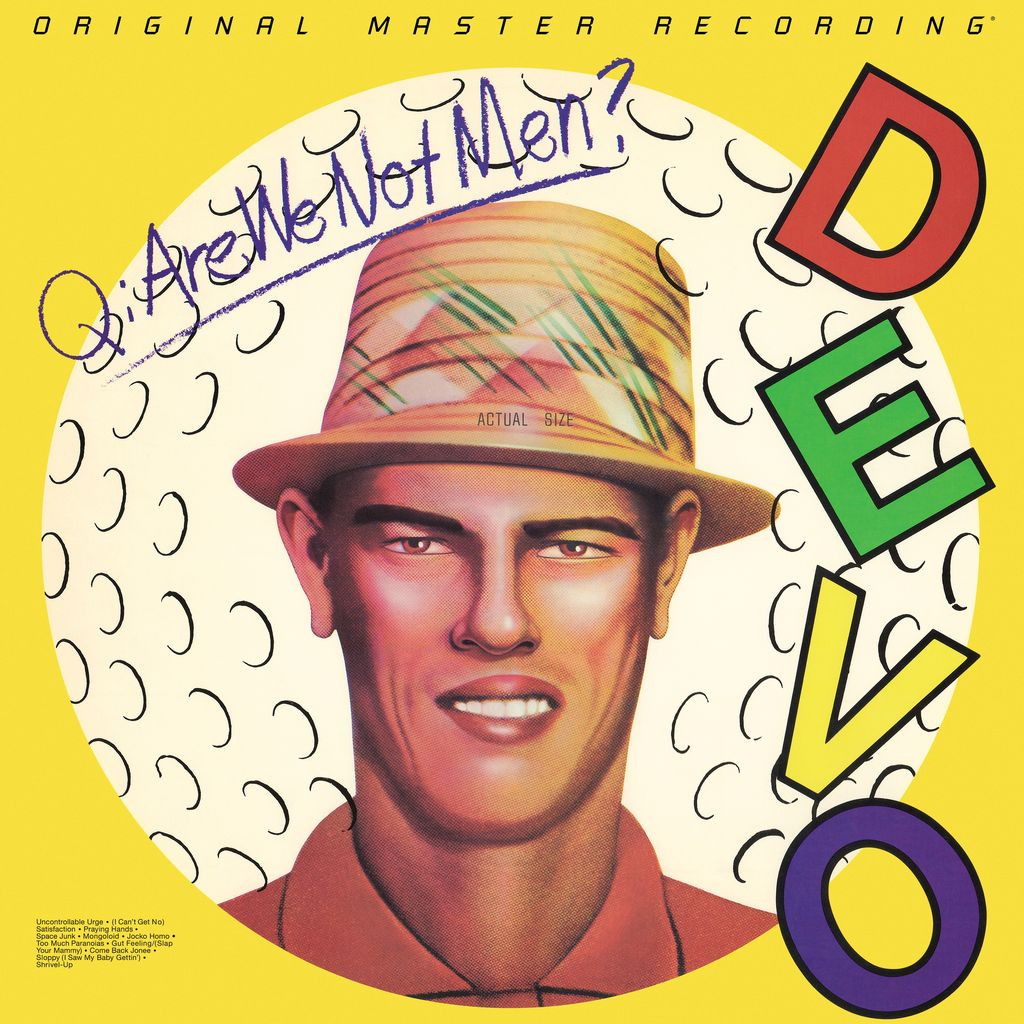
Musicians :
Mark Mothersbaugh (keyboards, synthesizers, vocals), Bob Mothersbaugh (lead guitar, vocals), Gerald V. Casale (bass guitar, keyboards, vocals), Bob Casale (rhythm guitar, keyboards, vocals), Alan Myers (drums), Brian Eno (synthesizers, treatments, backing vocals), Robert Margouleff (synthesizer programming).
- Social Satire, Deadpan Humor, and Twitching New-Wave Elements Protest Conformity on Q : Are We Not Men ? A: We Are Devo ! : Devo Debut Includes “Jocko Homo” and Deconstructionist Cover of “(I Can’t Get No) Satisfaction” !
- Hear the 1978 Record Rolling Stone Ranks the 252nd Greatest Album of All Time in Reference Sound : Mobile Fidelity’s Numbered-Edition 180 gram 45 RPM (2 LP) Set Reveals Copious Nuances and Textures !
- 1/4” / 15 IPS analog master to DSD 256 to analog console to lathe !
The satirical protest, spastic structures, and deadpan humor of Q : Are We Not Men ? A : We Are Devo ! run so deep that it took decades for the music cognoscenti to come around and appreciate the record on its own terms. Ranked the 252nd Greatest Album of All Time by Rolling Stone and amid the 100 best efforts of the 1970s by Pitchfork, Devo's radical debut helped steer the new-wave movement that followed. And as fate would have it, it is more relevant in the 21st century than at the time of its release.
Sourced from the original master tapes, pressed at Fidelity Record Pressing in California, and housed in a Stoughton gatefold jacket, Mobile Fidelity's numbered-edition 180 gram 45 RPM (2 LP) set presents the 1978 benchmark in reference-grade sound. Benefitting from the extra groove space on this first-ever 45 RPM version by playing with enhanced definition, deep-black backgrounds, and ultra-quiet surfaces, it reveals previously buried nuances and portrays soundstages whose scope is limited only by the capacity of your audio gear.
The presence, clarity, and detail of this reissue render in three-dimensional fashion the textures, tones, and effects critical to the music. Though Brian Eno butted heads with the band during the recording process, the merits of his production emerge like never before. The treatments that turn Devo’s keyboards into the equivalent of futuristic machines; the metallic effects and pointed sharpness of the percussion; the various voices that emerge in the distance; the sonic symmetry of the arrangements; the herky-jerk motion of the singing; the stickiness of the bizarre time signatures: Q : Are We Not Men ? A: We Are Devo ! comes across like a pointillistic painting seen up-close.
One made by what Devo claimed were "suburban robots here to entertain corporate life forms". Of course, leader Mark Mothersbaugh and company were fully human. The Ohio-based group cut its teeth while several members attended Kent State as art-school students. By the time Devo settled on the lineup that would create Q : Are We Not Men ? A: We Are Devo !, it had finely honed the songs and attracted the attention of David Bowie, Iggy Pop, and multiple record labels.
Innovators like Bowie, who remixed the album, counted themselves among a limited audience who picked up on the group’s brilliant wit and tongue-in-cheek stance. Couched in everything from the record’s title to the lyrics and architecture, let alone the band’s name, Devo’s send-up of social dysfunction, conspicuous consumption, and conformist behavior maintained that institutions, culture, and humankind continue to regress rather than advance. That “devolution” plays out in the strict precision, mechanical rhythms, and black-and-white certainty of the animatronic songs.
Originally misunderstood as a joke or novelty act by many critics and listeners, Q : Are We Not Men ? A: We Are Devo ! gained credibility and clout with passing of time. Decades later, its relevance in a landscape filled with virtual realities, artificial intelligence, blurred truths, lab-processed clones, repressed emotions, and social-media pressures to submissively follow so-called influencers is greater than anything even Devo could’ve foreseen. The environments at which the quintet hinted on the album corporations as people and vice versa; microchips taking the place of brains and souls; out-of-hand desires trumping sensibility; mind-crushing fears dictating thought took up residence in everyday reality.
The prophetic nature of Devo’s initial batch of songs cannot be overstated. Skittery, jagged, and shaking along with the ghosts of early rock ‘n’ roll, the opening “Uncontrollable Urge” sets the table for what follows. The band then tears down the Rolling Stones’ "(I Can’t Get No) Satisfaction” to its studs, the terse minimalism and icy emotion indicative of the devolution addressed throughout the record. Another rock hero, Chuck Berry, receives a nod on “Come Back Jonee”, the tune’s name and guitar fills referencing “Johnny B. Goode”.
Though somewhat controversial, “Mongoloid” pulses with frequency modulated synthesizer lines, crunchy riffs, and proto-electronic beats as it relays the story of a disabled protagonist who not only thrives but attains levels of happiness off-limits to everyone else in the diminished society. Its equally famous B-side, the call-and-response anthem “Jocko Homo”, goes one step further, rendering moot any notion of advancement by questioning the entire idea and purpose of mankind.
“Are we not men ? We are Devo !” the group repeatedly asserts. A truth that seems more evident with each passing day.