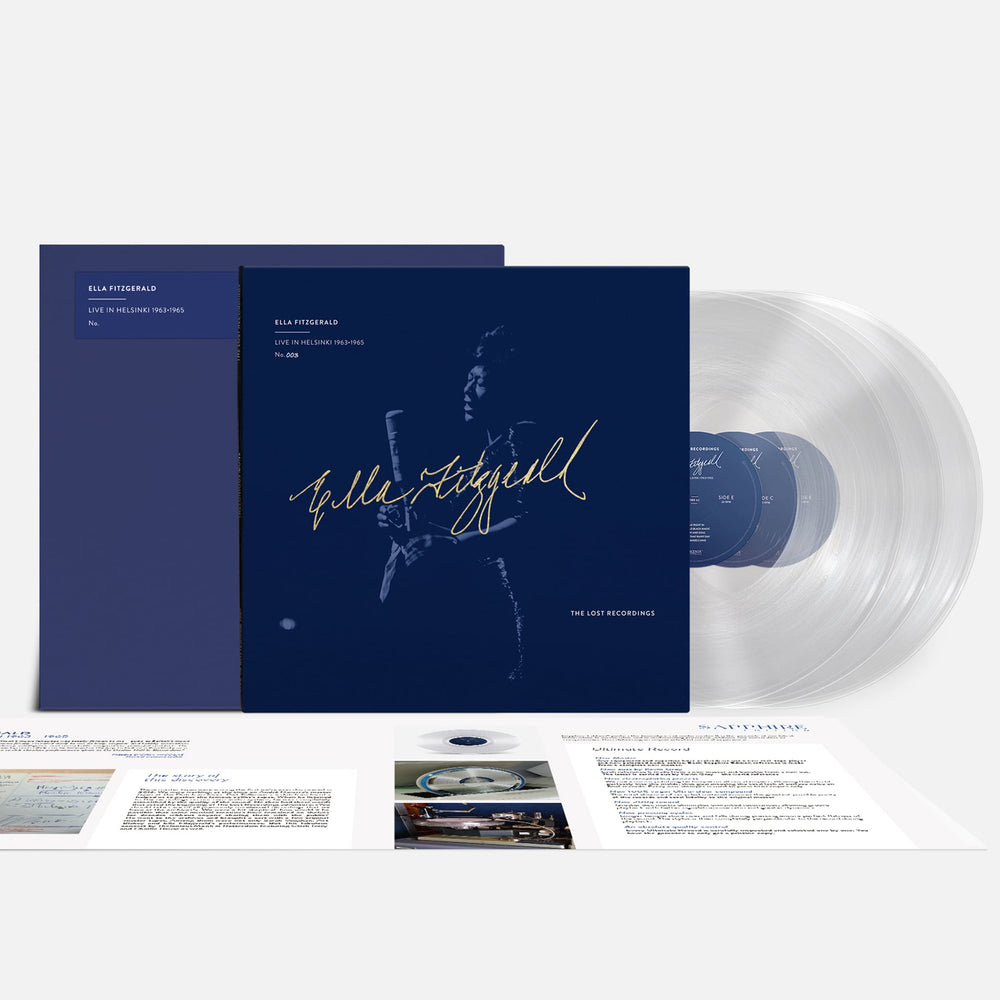
- Phoenix Mastering™ restoration from the original analog tapes !
- Engravings by Kevin Gray !
- Validation of 180 gram test pressings in our studios !
- New stampers every 500 copies !
- Slow pressing cycle !
- Unrivaled quality control in Europe !
- New tip-on gatefold printed in Italy !
Sapphire Edition® pushes the boundaries of audio media. It represents the culmination of our latest innovations in restoration and manufacturing processes without any constraints or compromises delivering an unprecedented musical experience.
In 1960, Ella Fitzgerald bought a house in Copenhagen. What was the little girl from Virginia doing in the icy Danish winters? A moment of madness? Partly, because she had once again fallen in love, this time with a Swede. However, it wasn't entirely by chance. Norman Granz, her mentor, friend, and producer, had decided to go into exile in Switzerland around the same time. He was tired of fighting in an America sick with racism, the Cold War, and witch hunts.
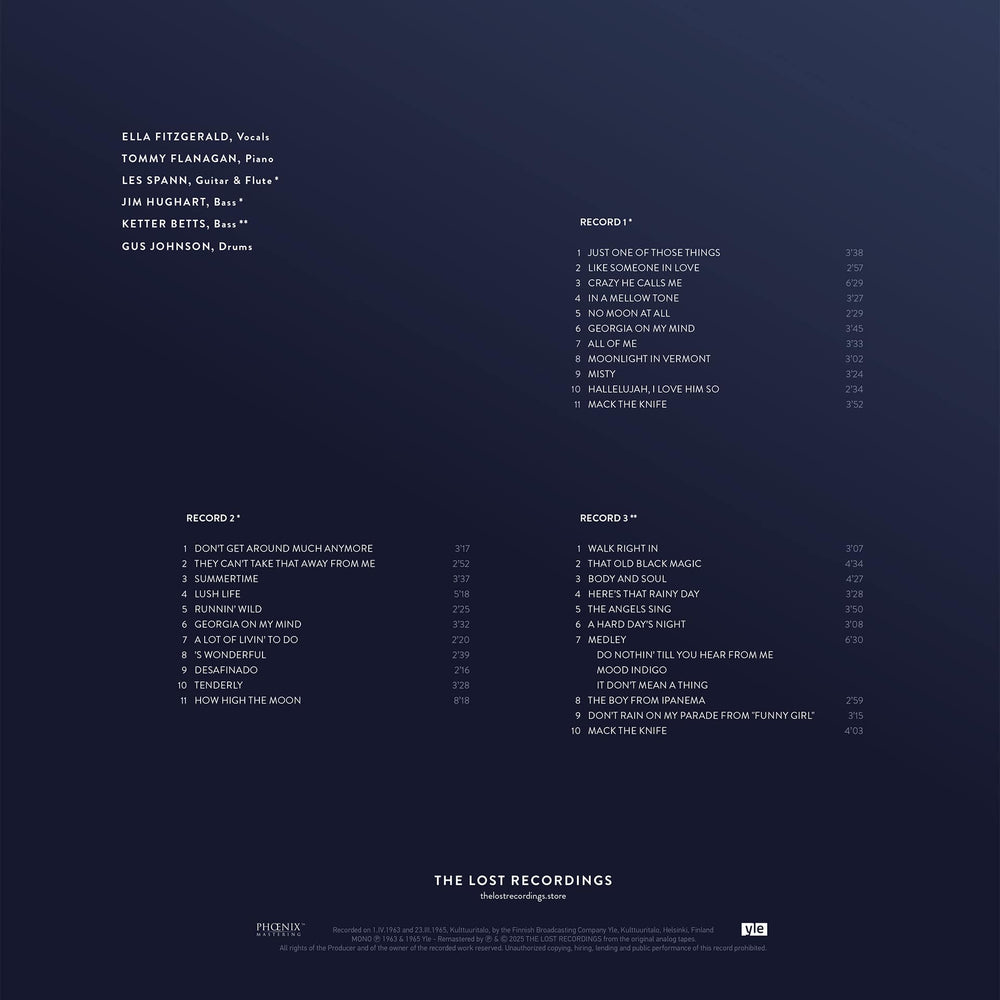
Ray Charles, Miles Davis, and many other Black musicians were also victims of this absurd hatred. Europe became their new Eldorado. Norman preceded them. Ella followed. However, she did not leave the United States, where she continued to fight against obscurantism by supporting Martin Luther King and appearing with her "sister," the blonde Marilyn Monroe. Nevertheless, her European tours multiplied. She spoke German in Berlin, French in Paris, Italian in Rome, and English in Helsinki, where she performed two memorable concerts in April 1963 and March 1965. She was close to Copenhagen. What is certain is that she was happy. You can feel it.
It took months of discussions and two successive trips to Helsinki to finally discover the recordings of these concerts, previously unreleased on disc. How can one not feel, upon listening to them, Ella's virtuosity, bordering on acrobatics, and vocal qualities whose richness and tonal assurance remain undiminished? Her stage presence is magnetic for this imposing woman who, backstage, has retained her childhood anxieties and shyness.
After these concerts, one understands how Ella's musical legacy transcends the simple framework of jazz. Her repertoire encompasses not only the composers of the famous Great American Songbook, such as Cole Porter, Irving Berlin, and George Gershwin, but also Broadway musical hits, Beatles songs, and South American rhythms. The final mystery of her is that she has no limits. She sweeps everything before her. Her timbre, her style, her presence remain instantly recognizable. Ella is inimitable. Whether she lives in Harlem, London, Los Angeles, Copenhagen, or Helsinki, she remains the embodiment of swing, scat, and jazz. Ella is Music.