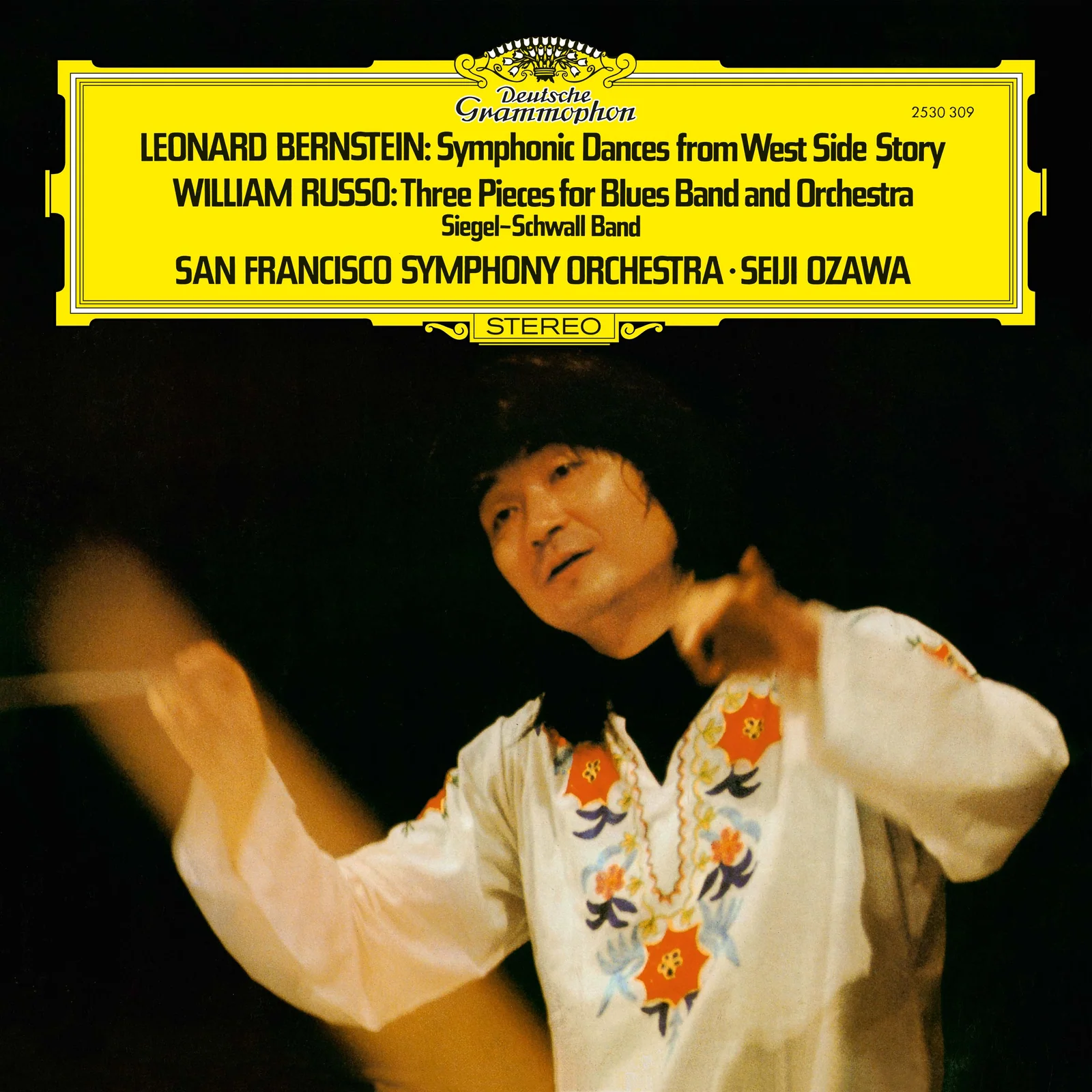
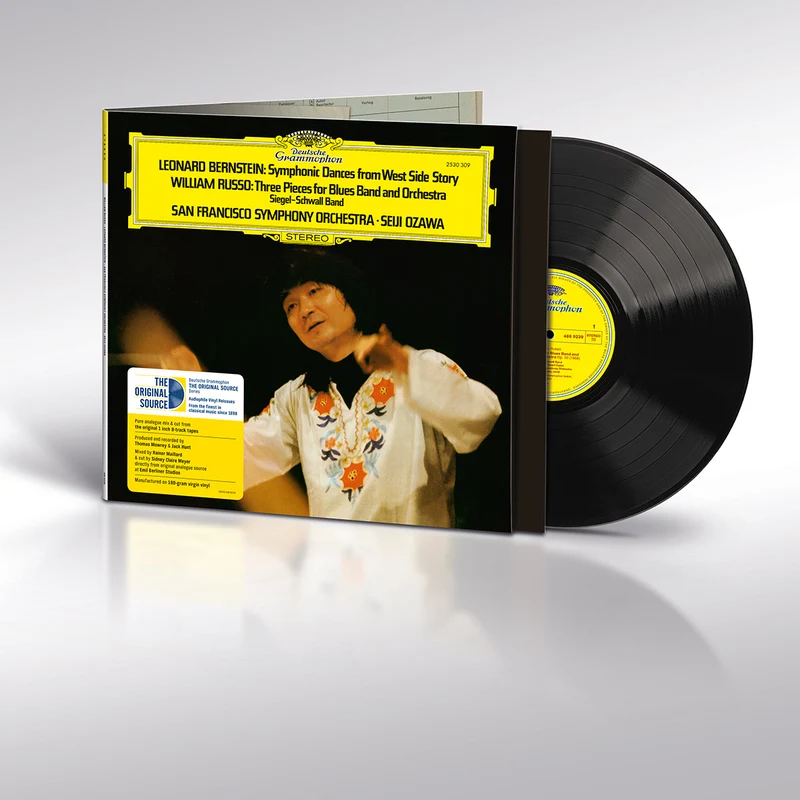
- Leonard Bernstein – Symphonic Dances from West Side Story / William Russo – Three Pieces for Blues Band and Orchestra !
- San Francisco Symphony Orchestra – Seiji Ozawa – Siegel-Schwall Band !
- Deutsche Grammophon – The Original Source Series – Limited & Numbered Edition – 180 gram AAA Stereo Vinyl LP !
Originally released by Deutsche Grammophon in 1973, this remarkable recording brings together two contrasting yet complementary masterpieces of twentieth-century American music, performed by the San Francisco Symphony Orchestra under the inspired direction of Seiji Ozawa.
Combining Leonard Bernstein's electrifying Symphonic Dances from West Side Story with William Russo's groundbreaking Three Pieces for Blues Band and Symphony Orchestra, Op. 50, the album explores the fascinating relationship between classical orchestral traditions, jazz, blues, and American popular music.
Under Ozawa's dynamic leadership, the San Francisco Symphony Orchestra demonstrates exceptional versatility, moving effortlessly between Bernstein's rhythmically explosive orchestral writing and Russo's innovative fusion of symphonic music with the expressive freedom of an authentic Chicago blues band.
William Russo – Three Pieces for Blues Band and Symphony Orchestra, Op. 50
Composed in 1968, William Russo's Three Pieces for Blues Band and Symphony Orchestra represents one of the most imaginative attempts to bring together the seemingly contrasting worlds of classical orchestral music and electric blues.
Russo, an accomplished composer and arranger whose career included collaborations with Stan Kenton, developed a distinctive musical language combining jazz harmonies, blues traditions, and sophisticated orchestral structures.
The work features the celebrated Siegel-Schwall Band, whose authentic Chicago blues sound provides a striking contrast to the rich textures of the San Francisco Symphony Orchestra.
The ensemble features harmonica player and electric pianist Corky Siegel, guitarist Jim Schwall, bassist Al Radford, and drummer Shelly Plotkin.
Rather than simply incorporating blues-inspired melodies into conventional orchestral arrangements, Russo allows the blues musicians considerable freedom to improvise, creating a genuine musical dialogue between the band and the symphony orchestra.
Part I introduces the work's distinctive musical character through a fascinating interplay of orchestral textures, blues phrasing, and rhythmic contrasts. The expressive harmonica and guitar passages establish an unmistakably American atmosphere, while the orchestra contributes dramatic harmonic colors and structural depth.
Part II develops a more expansive musical conversation between the two ensembles. The blues musicians explore their improvisational freedom against increasingly sophisticated orchestral accompaniment, creating moments of tension, lyrical reflection, and unexpected musical beauty.
The celebrated Mambo bursts into life with explosive brass passages, driving percussion, and irresistible Latin rhythms. This exhilarating movement demonstrates the San Francisco Symphony Orchestra's exceptional rhythmic precision and dynamic power.
Cha-cha introduces a more restrained and elegant atmosphere, followed by the intimate Meeting Scene, whose delicate musical character evokes the developing relationship between Tony and Maria.
The brilliant Cool Fugue combines sophisticated contrapuntal writing with the unmistakable rhythmic language of jazz, revealing Bernstein's extraordinary ability to integrate classical compositional techniques with contemporary American musical styles.
Rumble brings dramatic intensity to the forefront, its aggressive rhythms, powerful brass writing, and turbulent orchestral textures portraying the tragic confrontation at the heart of the musical.
The suite concludes with the deeply moving Finale, returning to the emotional world of Somewhere and bringing the work to a poignant and reflective conclusion.
Throughout these nine interconnected movements, Seiji Ozawa captures the extraordinary theatrical energy, rhythmic sophistication, and emotional depth of Bernstein's orchestral masterpiece.
Deutsche Grammophon – The Original Source Series
This exceptional audiophile reissue belongs to Deutsche Grammophon's prestigious The Original Source series, dedicated to rediscovering outstanding analog recordings from the 1970s through an uncompromising all-analog remastering process.
For this edition, the original 1-inch, 8-track master tapes have been used directly for the remastering and cutting process.
At the renowned Emil Berliner Studios, specially developed technologies allow the original multitrack recordings to be mixed, mastered, and cut entirely in the analog domain, preserving the authenticity and musical integrity of the original performances.
This 100 % analog (AAA) production process offers significant sonic improvements, including greater instrumental clarity, more natural tonal textures, enhanced spatial definition, and an extended dynamic range, while reducing background noise, distortion, and compression.
The result is a remarkably engaging listening experience, particularly suited to the contrasting musical textures of this extraordinary recording.
The explosive orchestral dynamics of Bernstein's Symphonic Dances benefit from improved separation and instrumental definition, while Russo's innovative combination of electric blues instruments and symphony orchestra gains exceptional presence, tonal richness, and rhythmic impact.
Pressed on premium 180 gram vinyl, this limited and individually numbered edition is presented in a luxurious deluxe gatefold sleeve featuring the original artwork, additional photographs, and facsimiles of the original recording documentation and tape boxes.
Bringing together the dramatic brilliance of Leonard Bernstein, the adventurous musical imagination of William Russo, and the inspired conducting of Seiji Ozawa, this exceptional recording stands as a fascinating celebration of American musical creativity.
A particularly rewarding addition to any collection devoted to twentieth-century classical music, orchestral jazz, blues, and outstanding all-analog audiophile recordings.